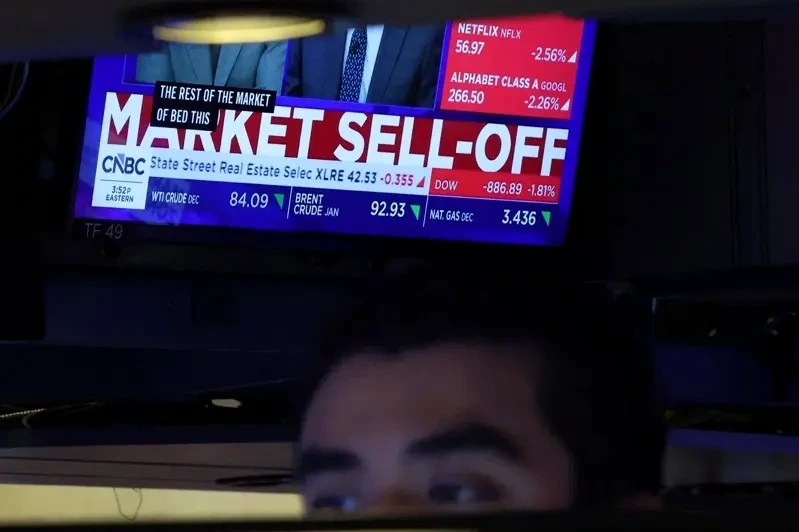
U.S. stocks retreated across the board, driven by a sharp sell-off in chipmakers and AI-related stocks. Investors will be closely watching inflation data, Black Friday consumer spending, and tech sector earnings next week to gauge whether the market rout can be halted.
Selling pressure intensified toward the close of Friday’s session. The PHLX Semiconductor Sector index plunged 10.7%, with Nvidia tumbling 14% and TSMC’s ADRs falling 9.5%. Both the S&P 500 and the Dow Jones Industrial Average have entered correction territory, while the Nasdaq recorded its worst weekly performance since March 2020. Next week’s inflation figures, year-end holiday shopping trends, and tech earnings will test whether the downward momentum can stabilize. Analysts caution that even a strong rebound would not necessarily signal that the selling pressure has run its course.
The S&P 500 fell 3.7% on Friday, marking its seventh consecutive day of losses—the longest losing streak since February 2020. The index is now down 11.6% from its October 6 high, placing it—along with the Dow Jones Industrial Average—in correction territory. The Nasdaq Composite plummeted 5.3%, erasing all of its gains for the year; it fell approximately 10% for the week, marking its worst weekly performance since March 2020.
Capital has shifted toward government bonds as a safe haven, pushing the yield on the 10-year U.S. Treasury note down by approximately 0.1 percentage points to 4.94%. Meanwhile, the VIX volatility index climbed as high as 40—its highest level since April 2025.
The PHLX Semiconductor Sector (SOX) index has fallen 43% from its June peak. On Friday, the sell-off spread across the memory, storage, and AI chip sectors: SanDisk plunged 16%, Micron fell 14%, and Western Digital, Broadcom, and Marvell each dropped by roughly 12%.
Nvidia has shed nearly 50% of its value since its early October peak. The sell-off intensified further following a Reuters report that the U.S. Securities and Exchange Commission (SEC) is investigating the company’s accounting practices.
Anthropic also failed to sustain its momentum; after closing up 17% on its first day of trading Thursday, the stock fell 9.1% on Friday, bringing its price back near the initial offering level. In total, companies within the Nasdaq Composite Index have seen more than $4 trillion in market capitalization evaporate this week.
Alex Witten, co-head of Americas equity business at Nomura, noted that the market is not being driven by a single event, but rather by a persistent lack of “enough good news to offset the bad.” Jim Russo, a portfolio manager at AllianceBernstein, stated that his firm began trimming positions in semiconductors and other stocks benefiting from AI infrastructure spending as early as this summer—a stance that has since turned even more bearish. He believes that the growth in AI-related spending has begun to slow and is likely to decelerate further in the coming years.
The First Hurdle Next Week: Can Inflation Ease Pressure for Interest Rate Hikes?
With U.S. stock market trading hours shortened next week due to the Thanksgiving holiday, investors will be keeping a close eye on inflation, consumer confidence, and revised third-quarter GDP figures—with inflation being the factor most likely to influence interest rate expectations.
Earlier this week, Federal Reserve Governor Christopher Waller suggested that a 50-basis-point (0.5 percentage point) rate hike might be necessary in December. However, following a sharp decline in the stock market, traders are no longer fully banking on a 25-basis-point (0.25 percentage point) hike for December.
If next week’s inflation data proves less severe than the market fears, it could alleviate investor concerns regarding a potential 50-basis-point hike by the Fed. Nevertheless, Neil Dutta, head of economic research at Renaissance Macro Research, cautions that a market shift away from expecting Fed rate hikes is not necessarily a positive development. He notes that such a shift could imply that the stock market has further to fall; furthermore, if the Fed were to pause its rate hikes, it could potentially fuel a resurgence in inflation.
Second Hurdle: Can Consumer Spending Sustain the Economy and Earnings Reports Stabilize Tech Stocks?
Next week’s “Black Friday” marks the beginning of the year-end holiday shopping season. The market will be watching closely to see whether consumer spending—which accounts for roughly two-thirds of the U.S. economy—can offset the pressure caused by a cooling in AI-related investment.
Jim Baird, Chief Investment Officer at Plante Moran Financial Advisors, notes that if consumer spending remains robust, it will help support the economy, subsequently boosting corporate revenue and earnings, and providing upward momentum for sectors beyond AI.
Oxford Economics projects that retail sales during the November and December holiday season will grow by 4.2%—an increase of 2.2% in real terms, adjusted for inflation. However, it remains to be seen whether a decline in the stock market—which may leave households feeling less wealthy—combined with persistently high energy and food prices, will dampen the willingness to spend.
Dell and semiconductor company Analog Devices (ADI) are also set to release their earnings reports next week, which should offer fresh insights into corporate spending and the demand for technology.
Stage 3: Is a Rebound a Sign That the Sell-off Has Ended, or an Opportunity to Trim Positions?
The Relative Strength Index (RSI) for the S&P 500 fell below 30 on Friday, signaling that the index has entered “oversold” territory—a condition that often precedes a rebound. However, a strong rebound does not necessarily mean the downward trend has concluded.
Jay Woods, Chief Market Strategist at Freedom Capital Markets, notes that sharp rallies can occur even within a broader downtrend; investors should remain prepared for significant volatility.
Katie Stockton, founder of Fairlead Strategies, advises against selling during a rapid decline, suggesting instead that investors wait for a rebound before evaluating whether to trim their positions. She believes the long-term upward momentum of major indices has weakened, meaning any subsequent rebound may lack staying power—which is why she does not recommend increasing exposure at this time.
Others argue that a market correction does not inevitably spiral into a full-blown bear market. Chris Larkin, a strategist at E*Trade, points out that since 1983, there have been 15 instances where the market corrected from an all-time high, yet only five of those episodes descended into a bear market.
Moving forward, investors will need to be more selective with individual stocks. David Miller, Chief Investment Officer at Catalyst Funds, observes that while investors remain bullish on AI, they are no longer willing to pay an excessive premium for growth prospects. In the long run, the share prices of companies in this sector will depend on whether their AI investments can consistently generate profits and free cash flow.