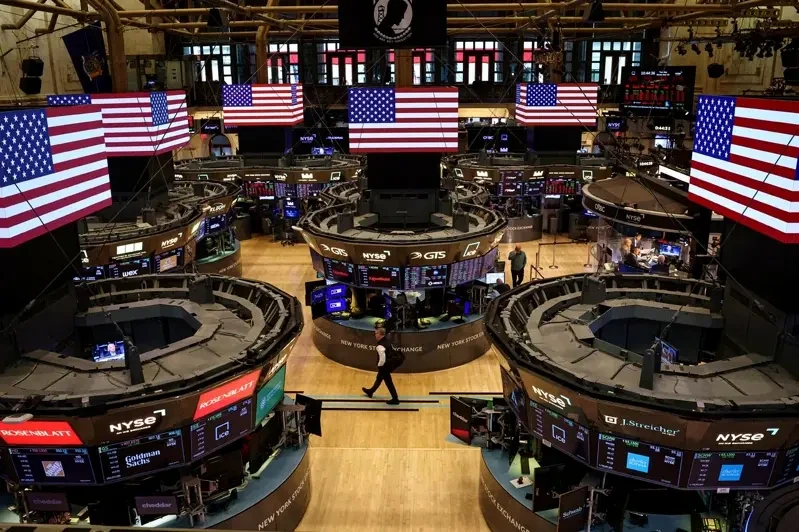
U.S. stocks weakened on Tuesday, pressured by a higher-than-expected Consumer Price Index (CPI) and hawkish remarks from Federal Reserve officials. These developments led the market to assign a higher probability to an interest rate hike in December, while the technology sector was further weighed down by a sharp decline in Nvidia shares.
All four major U.S. stock indices closed slightly lower on Tuesday (the 10th). The higher-than-anticipated inflation data fueled market expectations for a Federal Reserve rate hike next month. Furthermore, a key Fed official hinted at the possibility of a 50-basis-point (0.50%) rate hike, raising investor concerns that the central bank might adopt a more aggressive monetary tightening stance.
On the 10th, the Dow Jones Industrial Average fell 157.86 points (0.30%) to close at 52,231.89; the S&P 500 index dropped 29.01 points (0.38%) to 7,520.93; and the Nasdaq Composite index declined 187.26 points (0.74%) to 25,065.87.
The Philadelphia Semiconductor Index fell 35.60 points, or 0.35%, to close at 9,998.33.
Nvidia shares plunged more than 5%, weighing on the three major U.S. stock indices. The stock failed to participate in Monday’s tech-led rally. This follows an admission by CEO Jensen Huang over the weekend that he had an extramarital affair with an individual suspected of being a Chinese spy.
The U.S. Department of Labor reported that the Consumer Price Index (CPI) rose 0.4% month-over-month last month. This marks the third consecutive month in which the index has increased by 0.4% or more—surpassing the 0.3% rise anticipated by economists surveyed by Reuters—following a 0.6% increase in September.
Federal Reserve Governor Christopher Waller stated that the Fed should raise short-term borrowing costs in December, even if recent data suggests some cooling in inflation. He added that if the inflation situation worsens, the central bank should consider a larger, half-percentage-point rate hike.
According to the CME FedWatch tool, the market has now fully priced in at least a 25-basis-point (0.25 percentage point) rate hike at the Federal Reserve’s December meeting—an increase from the 84% probability seen on Monday. Meanwhile, the expectation for a 50-basis-point (0.5 percentage point) hike—a scenario that was not even factored in during the previous trading session—has now climbed to 11.8%.
In addition to Waller, several other Federal Reserve officials who spoke on Tuesday also expressed hawkish views.
Dallas Fed President Lorie Logan stated that the Federal Reserve must raise interest rates at least two more times—by 25 basis points each—to curb inflation, and that swift action might be necessary. Meanwhile, Kansas City Fed President Jeffrey Schmid remarked that he considers the current policy rate to be “quite accommodative.”
Federal Reserve Governor Michelle Bowman, who oversees regulatory matters, did not explicitly call for a rate hike, though she acknowledged that addressing inflation remains the Fed’s top priority.
The yield on the 2-year U.S. Treasury note—which typically moves in tandem with interest rate expectations—surged by nearly 18.9 basis points to 4.736%. This marks its largest single-day increase since April 9, 2025, when Donald Trump announced the implementation of comprehensive global tariffs.
This jump in yields occurred even as oil prices retreated to a two-month low.
“The market is working through the possibility that the Federal Reserve might have to be more aggressive with rate hikes next year,” said Tom Hainlin, national investment strategist at U.S. Bank Asset Management. He added, “The latest CPI data suggests that inflation may be stickier—and could persist for longer—than previously anticipated.”
The S&P 500 and the Nasdaq had previously posted gains for two consecutive sessions, rebounding from a sharp sell-off last week triggered by concerns over potential government regulation of AI development.
On Tuesday, however, the S&P 500’s technology sector fell 1.4%, making it the worst performer among the 11 major sectors. This decline was driven largely by another drop in shares of Nvidia, which has plummeted a cumulative 9.6% over the past two trading sessions.
Investors are also closely monitoring the anticipated initial public offering (IPO) of Anthropic, expected later this month. The offering is projected to raise as much as $64.4 billion, potentially valuing the company—on a fully diluted basis—at up to $1.4 trillion.
Anthropic’s market debut could also force other AI giants to compete more aggressively for investor capital, while prompting investors to adjust their portfolios.